CHAPTER 01
A restaurant should not need ten dashboards to serve one guest
A reservation looks simple from the guest's perspective. Choose a time, choose the number of people, receive a confirmation and arrive. Inside the restaurant, the same reservation starts a much more complicated process. Someone must decide how many guests can be seated, which tables can be combined, how long each party is likely to stay, whether the kitchen can handle a sudden arrival wave and what to do when somebody cancels at the last minute.
Then there is everything that happens outside the dining room. A guest may want takeaway tomorrow. Another customer orders delivery on Friday. A regular asks for an allergy note to be remembered. A manager wants to know which campaigns brought people back. A restaurant with its own riders wants visibility into deliveries without losing control of its customer experience.
Too often these activities sit in separate tools: a reservation book, an ordering website, a delivery marketplace, a customer list, a marketing service and a collection of spreadsheets. Each product may solve its own problem well. The difficulty appears when the restaurant needs the complete picture.
Our conviction is straightforward: restaurant technology should follow the guest relationship, not force the guest relationship to follow the software. MealApp Manager was designed around that ambition—bringing reservations, guest management, direct ordering, takeaway and delivery operations into a more connected experience.
This does not mean every restaurant needs every feature. A small café may need a reliable booking widget and clear table availability. A fine-dining venue may care most about deposits, special experiences and guest preferences. A busy takeaway concept may care more about order flow, delivery radius, pickup time and the reliability of its riders. The right software should match the real operating model.
CHAPTER 02
What is restaurant reservation software?
Restaurant reservation software is the system a venue uses to accept, organize and manage table bookings. At its simplest, it replaces a paper diary with a searchable digital reservation book. At its most advanced, it supports floor plans, rules for availability, guest profiles, automated communications, deposits, waitlists, analytics and integrations with other restaurant systems.
A useful booking system must work for two audiences simultaneously. Guests need a quick and reassuring booking journey. Staff need accurate information under pressure. A beautiful form is not enough if it regularly produces overbookings, confusing table assignments or inaccurate service capacity.
When evaluating any reservation solution, ask how it handles five realities: different service periods, different party sizes, walk-ins, last-minute changes and the guest who returns. These everyday cases tell you more than a long list of feature names.
Direct online booking means customers can reserve through a restaurant-controlled channel such as its own website or embedded widget. Marketplace booking means customers discover and reserve the restaurant through a third-party consumer platform. Both can be valuable, but they offer different benefits: a direct channel reinforces the venue's brand, while a marketplace may provide access to additional demand.
CHAPTER 03
Why we created MealApp Manager
MealApp started with a question that still guides the product: what would restaurant management look like if bookings, customers, orders and delivery were treated as connected parts of the same business?
Our purpose is not to argue that every established reservation system is bad. Many have built excellent tools and valuable restaurant communities. Our purpose is to give operators another option: one designed around greater operational control, clearer direct customer journeys and the possibility of running more of the restaurant's activity in one place.
We believe a restaurant's technology stack should help answer practical questions. Who is coming tonight? Who has visited before? Which reservations need attention? What takeaway orders are being prepared? Which delivery needs a rider? How can a guest return without having to discover the restaurant again from zero?
That is the reason we bring booking management, customer context, direct ordering, takeaway and delivery workflows into the MealApp Manager ecosystem. We want technology to become quieter during service: easier for the team to use, easier for the guest to understand and easier for the owner to evaluate financially.
The MealApp philosophy: your restaurant's identity comes first; the software should support it. The aim is to build direct relationships where possible, benefit from marketplaces where useful and keep the operational model understandable. We are not asking operators to abandon every channel. We are asking them to understand what each channel costs, what it contributes and how the channels fit together.
CHAPTER 04
What makes an excellent online restaurant booking experience?
Guests often decide whether to book in seconds. They need to know they selected the right restaurant, date, time and party size. Forms should be easy on mobile, clearly explain unavailable times and avoid forcing unnecessary steps. Confirmation should explain what happens next, including cancellation rules when relevant.
For the restaurant, the experience must be configurable. A Wednesday lunch and a Saturday dinner rarely have identical requirements. Some venues operate fixed seatings; others prefer rolling availability. A large group may require different conditions from a table for two. A terrace may open only when weather and staffing permit.
Look beyond the booking button. Ask whether the system manages availability accurately, records phone reservations, supports walk-ins and communicates changes to the team. Ask whether it remembers relevant guest preferences in a privacy-conscious way. Ask whether reservations arriving through different channels can be viewed together without confusion.
A good platform also makes operational rules visible to the people who use it. Staff should not need to understand a technical configuration diagram to know why a table can or cannot be booked.
CHAPTER 05
Table management is about service, not just seating charts
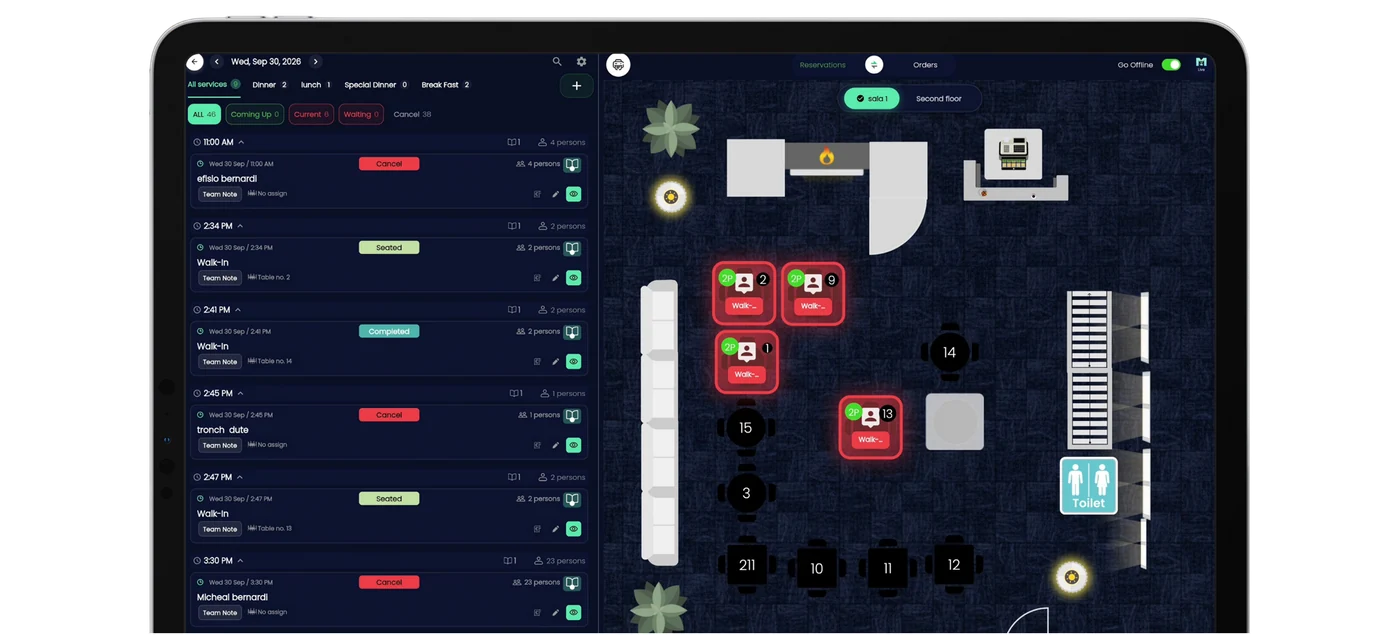
A digital floor plan can make a busy service more predictable. It shows how many guests are expected, which tables are assigned and where potential bottlenecks may occur. But effective table management is not about squeezing every possible booking into the room. It is about balancing occupancy, hospitality, staffing and kitchen capacity.
Consider a restaurant with ten tables. Five simultaneous arrivals at 7:30 p.m. may look attractive on a spreadsheet, yet overwhelm the kitchen and front-of-house team. A system that helps distribute arrivals may offer more value than one that only maximizes the theoretical number of covers.
When testing reservation software, simulate real service: a guest arrives late; a four-person party becomes five; a table remains occupied longer than expected; another customer asks to move to the terrace; a walk-in appears just as a cancellation arrives. These are the moments in which a reservation system earns its place.
MealApp Manager's reservation offering includes occupancy management and table-related workflows. Ask for a live demonstration using your actual floor plan and service rules rather than assuming a feature list guarantees a good fit.
CHAPTER 06
No-shows, late cancellations and the value of a protected table
An empty table after a no-show is not always recoverable. Ingredients have been prepared, staff are scheduled and another guest may have been turned away. Yet not every restaurant needs strict deposits for every reservation. The objective is to choose a no-show policy proportional to the venue's risk.
Useful tools include clear confirmations, reminders, reconfirmation flows, cancellation windows, card guarantees, deposits and advance payment for specific experiences. The best combination depends on the restaurant, the audience and local legal requirements. Policies should be explained before the customer confirms.
A neighbourhood bistro might use reminders and a simple cancellation policy. A tasting-menu restaurant could consider deposits for selected evenings. A venue hosting a prepaid event might collect the price in advance. There is no universal formula, and software cannot eliminate no-shows entirely.
MealApp offers reservation reminders and booking-condition tools as part of its reservation positioning. Verify the exact availability and payment flow for your plan and country during onboarding. Ask about payment conditions and the policy appropriate for your venue; no tool guarantees that all guests will attend.
CHAPTER 07
Your guest database is a relationship, not a spreadsheet
A regular guest may return because the food is excellent. They are more likely to feel recognized when the team remembers that they prefer a quiet table, celebrated an anniversary recently or asked about a dietary requirement. Guest information can help hospitality become more personal, provided it is used with appropriate consent and care.
A restaurant CRM—customer relationship management system—can connect booking history, preferences, notes and communications. Its purpose is not to collect data for its own sake. It is to help teams provide better service and make relevant contact with people who have chosen to hear from the restaurant.
Evaluate whether a platform clearly separates operational messages from marketing consent. Can staff correct information? Is data access controlled? How can guests exercise their privacy rights? Can the restaurant export its information? What happens when it switches providers?
MealApp Manager positions guest notes, booking history and CRM features within the same broader operating environment. The promise should always be supported by transparent data processing information and a working product demonstration.
CHAPTER 08
Direct bookings and marketplace visibility serve different purposes
The debate over direct versus marketplace bookings is often presented as a battle where one side must win. In practice, smart restaurant operators ask a more useful question: which mix of channels produces profitable, loyal guests?
A marketplace can introduce your restaurant to someone who has never heard of it. A direct website can make it easier for an existing customer to come back. Social platforms may help diners discover menus, atmosphere and opening hours before they choose to reserve.
Those channels should not be confused. Marketplace discovery, reservation software and direct booking widgets are related services, but they are not identical products. When comparing fees, distinguish subscription charges, marketplace booking fees, payment processing, optional marketing products and other services. Do not compare one provider's base subscription with another provider's complete acquisition package as though they were the same thing.
The practical goal is to make the restaurant bookable where guests already are while building a direct relationship that can survive beyond a single transaction. MealApp Manager's emphasis on connected restaurant-controlled journeys is one way to pursue that goal; other platforms have their own approaches and strengths.
CHAPTER 09
Reservation software should connect with delivery and takeaway when the restaurant needs it
A reservation platform can be excellent without managing delivery. A delivery marketplace can bring in valuable orders without solving table management. But restaurants that operate both dine-in and off-premise services face an operational coordination problem: all those orders compete for the same kitchen, people and attention.
Imagine a restaurant that is fully seated on Friday evening while takeaway orders continue to arrive. The manager needs to understand preparation times and available resources. A new direct order should not cause confusion in the dining room. A rider's arrival should not surprise the kitchen. The ideal operational design makes the right information visible to the right team members.
MealApp Manager's published offering combines reservations, delivery and pickup in a Full Ecosystem plan. That positioning is materially different from buying a standalone reservation tool and then separately solving off-premise operations. It does not automatically mean MealApp replaces every POS, kitchen display, dispatch platform or third-party service. Integrations and exact workflows need to be verified individually.
CHAPTER 10
Private fleet delivery: your restaurant, your rider strategy
Many restaurant owners think of delivery only as a marketplace. But delivery actually consists of several separate jobs: attract the order, accept the payment, prepare the food, assign a courier, get the food to the customer and handle the relationship afterward.
Private fleet delivery means a restaurant uses its own couriers or delivery team for all or some of those deliveries. The value is control: how the team is scheduled, which areas are served and how the handoff works. It also creates responsibilities. Couriers must be managed; insurance and local employment or contractor obligations matter; delivery times must be realistic; and the true cost of each journey must be measured.
MealApp's delivery offering publicly describes support for own riders, as well as MealApp delivery coverage depending on location. This gives restaurants a useful question to explore: can direct orders, pickup and the delivery team be managed without having to depend on a marketplace for every step?
A restaurant with its own rider fleet may care about order assignment, distance rules, service zones and delivery tracking. A small venue without riders may prefer an external delivery option. Some restaurants will operate a mixture of both. The best system makes the available options and associated costs clear rather than claiming that one operating model is right for everyone.
Private fleet is not synonymous with free delivery. Vehicles, time, wages or contractor payments, insurance and failed deliveries still cost money. The real benefit is the opportunity to design and measure a delivery operation according to the restaurant's business model.
CHAPTER 11
The difference between 0% commission on direct orders and the actual cost of an order
A phrase like “0% commission” is attractive, but it must be precise. MealApp's published pricing describes 0% commission on direct orders for relevant plans. That does not mean there are no subscription charges, payment processing fees, rider costs, taxes or charges associated with other channels or optional services.
The distinction matters. A direct order placed through a restaurant-controlled flow is different from an order generated through a third-party marketplace. If a restaurant uses more than one ordering channel, every channel has its own acquisition economics and operational costs.
Here is an illustrative example, not a customer result. Suppose a restaurant receives 200 orders in one month with an average food basket of €30. That is €6,000 in food sales. A hypothetical marketplace commission of 25% on those sales would equal €1,500. A direct-order commission of 0% would mean no equivalent percentage-based direct-order commission—but the restaurant would still need to include the correct subscription, payment, advertising, packaging and delivery costs. It would also need to determine whether customers would have placed those orders directly without the marketplace's discovery channel.
This is why a good comparison shows total cost, not an isolated percentage. Use the actual quotations and terms for your market and your restaurant. Measure new-customer acquisition separately from repeat direct business. A successful channel strategy needs both visibility and margin discipline.
CHAPTER 12
One ecosystem, three connected apps: MealApp User, Manager and Rider
There are three distinct audiences in a restaurant transaction. A customer wants a simple way to find a place, book, order and enjoy food. A restaurant needs reliable tools to fulfill that promise. A courier needs a clear delivery task with the right address, pickup instructions and payment information. MealApp's broader product vision connects these audiences through MealApp User, MealApp Manager and MealApp Rider.
MealApp User is the consumer-facing experience for discovering participating restaurants and using available delivery, takeaway and dine-in services. MealApp Manager is the operating environment for restaurant owners and staff, bringing reservations, tables, menus, orders, guest relationships and relevant marketing tools into their day. MealApp Rider is the logistics experience supporting rider assignments and the delivery journey where the MealApp rider network operates.
The important distinction is not simply that there are three applications. It is that the same restaurant can aim to connect a guest's journey: discover a venue, reserve a table or order a meal, have a good experience, receive appropriate follow-up and return directly. One connected journey is more useful than three disconnected logos.
Availability varies by market, product version and restaurant configuration. The customer apps may be accessible in multiple countries, but that does not establish that restaurant onboarding, local delivery coverage or rider dispatch are operational everywhere. Confirm those details before making a geographic claim.
- Guest
- Booking / order
- Manager
- Rider / service
- CRM
- Relevant follow-up
- Repeat guest
Services depend on the restaurant configuration, plan and local availability. Marketing requires an appropriate basis.
CHAPTER 13
MealApp User: delivery, takeaway and dine-in in one customer journey
Customers do not divide their lives into 'reservation software' and 'online ordering software'. They ask simpler questions: where should we eat tonight, can I collect lunch on my way home, and can somebody deliver dinner? A connected consumer experience can make it easier to answer all three.
In the MealApp User experience, participating restaurants can be discovered and, when enabled for the venue, customers can explore menus, order delivery, choose takeaway or book a table. A repeat customer should be able to recognize the same restaurant, its products and its service options without starting the relationship from scratch each time.
For delivery, the experience should communicate the selected address, order summary, payment step, available promotions, order status and delivery updates. For takeaway, it should clarify pickup timing and handoff. For dine-in, it should make reservation choices and confirmations understandable. Each path needs a reliable exception process for changes, cancellations and help requests.
This matters to restaurant owners because a customer's relationship with the brand does not stop at a single transaction. A guest who enjoyed a table reservation may become a takeaway customer. A delivery customer may discover the dining room. The aim is convenience for the guest and a more complete customer journey for the restaurant, subject to consent and access rules.
CHAPTER 14
MealApp Manager: the operational command center, not another disconnected dashboard
A restaurant owner should be able to look at the day and understand what needs attention. Reservations approaching the next service, guests already seated, new pickup orders, a delivery awaiting assignment and a campaign scheduled for tomorrow are all parts of the same operation. MealApp Manager's proposition is to bring the relevant views together, rather than asking the team to maintain unrelated systems.
The core areas to demonstrate are reservation creation and changes, lunch and dinner availability, table mapping, walk-ins, customer notes, guest visit history, menu and item availability, order acceptance, order status, pickup and delivery management, rider coordination, staff permissions and reporting. CRM and marketing features extend the workflow beyond today's service into the next visit.
Operational details matter more than slogans. Can a staff member find a reservation in seconds? Can a manager pause orders during a kitchen rush? Can a dish that is unavailable be hidden immediately? Can the team distinguish a guest arriving in the dining room from an order waiting for a courier? Is the information accessible on the devices the staff actually use?
Not every module or feature is included in every subscription or enabled in every region. An honest product page should link each feature to its actual plan and live availability. An integrated ecosystem is valuable only when the integrations genuinely work.
CHAPTER 15
MealApp Rider and the practical reality of private-fleet delivery
Delivery combines hospitality with logistics. Guests need believable timing and a meal in good condition. Restaurants need a smooth handoff; couriers need clear pickup instructions and a destination. MealApp Rider supports the courier side of this journey.
MealApp's published offering describes own-rider options and MealApp-provided couriers where available. The public site currently invites riders around Antwerp. This does not establish coverage in every Antwerp postcode or outside Antwerp: confirm the service area, operating hours, charges and responsibilities for your restaurant.
Track kitchen readiness, rider assignment, pickup and delivery separately. Own-fleet operations still require rider payments, insurance, equipment, scheduling and support. Ask about the relevant contractual arrangement; availability of an app does not establish an employment relationship.
CHAPTER 16
The real objective: build a restaurant's independent customer base
A marketplace may introduce a diner to a restaurant, but an independent restaurant needs customers who remember its name and choose it again. This is not about declaring war on every marketplace. It is about making the venue's own identity, direct ordering link and permission-based customer relationship strong enough to become repeatable business assets.
Think of the customer journey as a series of opportunities. A guest discovers the restaurant and places a first order. The food and service are good. The package includes a clear, permitted invitation to order directly next time. The restaurant's website and social profiles link to its direct menu and booking widget. The customer can find useful offers, receive relevant messages if they opt in, and order again without searching a generic marketplace.
Over time, the owner measures first-time customers, returning guests, repeat orders, direct-channel share and contribution margin. The strongest outcome is not 'we sent ten thousand emails.' It is 'more customers choose us directly and return at a sustainable margin.'
MealApp can support this strategy through a connected restaurant experience, direct booking and ordering pathways, a CRM and configurable marketing features. It does not automatically transfer ownership of all platform users' personal data to a restaurant. Data access, consent, export rights and lawful marketing use depend on contract, privacy rules and product settings.
CHAPTER 17
Restaurant CRM: remember the relationship, not merely the transaction
A customer relationship management system is often described as a database. In a restaurant, a useful CRM is closer to institutional memory. It helps a team recognize an appropriate returning guest, understand previous visits and choose when a follow-up would be welcome. It turns scattered activity into an organized history that staff can actually use.
Useful guest attributes may include a customer identifier, preferred language, first and last visit, reservation frequency, average order value, preferred channel, no-show history where appropriate, opt-in status, relevant dietary or service notes provided voluntarily, loyalty activity and campaign engagement. The system should distinguish verified facts from staff assumptions and avoid collecting information that is not needed.
A restaurant can then ask: who came for the first time this month; who ordered twice recently; who has not returned in 90 days; who prefers pickup; which customers have explicitly agreed to receive promotional emails; which campaigns were followed by a subsequent booking or order?
A CRM creates value through relevant action, not through the largest possible list. Customer records should be deduplicated, permissions controlled, exports secured and deletion or objection requests respected. Sensitive preferences deserve special caution. Clear consent, retention policies and appropriate privacy and security processes are essential; obtain advice for your market.
CHAPTER 18
Segment customers intelligently instead of sending everyone the same promotion
A busy family ordering takeaway on Sundays does not have the same needs as a couple booking an anniversary dinner or an office coordinator arranging lunch. Sending all three the same Friday-night discount wastes attention and can weaken the brand. Segmentation helps restaurant marketing feel useful rather than intrusive.
Start with simple, understandable groups: first-time diners, first-time delivery buyers, repeat takeaway customers, VIP regulars, lapsed customers, customers who book but never order, customers who order but have never visited, birthday opt-ins and guests interested in particular services. Additional segments can use recency, frequency and monetary value (RFM), provided the underlying data is sufficiently accurate.
Here is a practical example. A pizzeria could invite customers who have ordered pickup three times to explore the new direct-order page, rather than paying to reach them through a marketplace campaign. A restaurant focused on dine-in could send a seasonal menu announcement to guests who requested news. A takeaway concept could offer a carefully costed bundle to customers whose purchase frequency has fallen.
Segmentation is not permission. A customer appearing in a CRM does not automatically mean a restaurant can send them marketing. The campaign engine must enforce consent, applicable soft-opt-in rules where relevant, frequency limits, suppression lists and unsubscribes.
CHAPTER 19
The first-visit flow: turn a happy experience into a reason to return
One of the highest-leverage moments in restaurant marketing comes immediately after the first completed visit or order. The customer now knows the food, packaging, service and brand. The restaurant can either allow the relationship to go quiet or create a thoughtful next step.
A good first-visit sequence begins with excellent service and a reliable receipt or confirmation. Where a lawful marketing basis exists, a short thank-you message can welcome the guest, share a direct booking or order link, explain how to find the restaurant on MealApp and invite them to opt into relevant updates. It should not pretend to know whether the customer loved the meal; instead, offer a feedback route that can also surface problems.
For example, one message might say: 'Thanks for choosing us. Next time, you can order directly from our restaurant page or reserve a table in just a few taps.' The call to action should be specific: Book your next table, Explore pickup or Order directly.
Measure the number of first-time guests who make a second purchase within 30, 60 or 90 days. Exclude cancellations, refunds and test transactions from the attribution. Use holdout groups where possible so the owner can tell whether the message created extra business or merely accompanied a return that would have happened anyway.
CHAPTER 20
Reservation follow-up: before the visit, after the visit and between visits
A reservation creates a sequence of operational and relationship moments. Before the visit, the guest needs the correct date, time, party size and cancellation information. Restaurants can send transactional confirmations and appropriately timed reminders. Guests may need an easy path to modify a booking or contact the venue. This improves clarity and can reduce avoidable misunderstandings.
After a completed reservation, a restaurant can ask for feedback and, where permitted, invite the diner back. The tone should differ from a payment confirmation or a no-show reminder. A guest who had an issue needs service recovery, not an automated coupon barrage. A guest who reserved for a special occasion may prefer a discreet invitation to another experience.
Between visits, the CRM can identify an appropriate interval for re-engagement. A venue with weekly lunch regulars operates at a different rhythm from a fine-dining restaurant where one visit every few months is normal. A one-size-fits-all 14-day win-back sequence would be inappropriate for many businesses.
MealApp Manager's reservation, guest-history and marketing proposition makes these workflows worth demonstrating in real product conditions. Confirm exactly which reminder, trigger, email or messaging features are live and available in the chosen plan. The example playbooks in this guide are not a promise that every automation is available.
CHAPTER 21
The repeat-order engine: delivery, takeaway and direct ordering
Restaurants often invest heavily in acquiring a first order but pay less attention to what happens next. Yet a customer who already likes the food may need nothing more than an easy direct link, a reliable reorder experience, clear pickup times and a brand they can remember.
A sensible retention engine starts with a clean direct-order path on the restaurant website and inside the relevant MealApp experience. It continues with accurate menus, product availability, useful photos, honest estimated times and a frictionless checkout. Order confirmation and delivery updates should reduce uncertainty. Packaging can reinforce the restaurant's identity rather than make the meal feel anonymous.
With permission, post-order messages can recommend relevant next steps: 'Order your favorite again,' 'Try pickup on your way home,' or 'Book a table to enjoy the full menu.' Some restaurants may use a limited-time offer, but the offer should be chosen based on gross margin rather than a habit of discounting every order.
Track direct-order share, second-order conversion, 30/60/90-day retention, average basket and net margin after delivery, payment, packaging and marketing. The goal is a restaurant that customers actively seek out—not a restaurant that must purchase access to every repeat customer.
CHAPTER 22
Email marketing that produces useful visits, not inbox noise
Email remains a valuable channel when people actually want to hear from the restaurant. Useful restaurant campaigns include seasonal menu launches, a midweek lunch special, a new takeaway option, reservation availability for a holiday, an invitation to a tasting event, a birthday reward where offered, a loyalty update and a well-timed reminder about the direct ordering channel.
The practical workflow is straightforward: obtain a lawful marketing basis, record the source and timestamp of consent where applicable, segment the audience, design a mobile-friendly message, use an honest sender identity, include a clear unsubscribe, send at sensible frequency and measure the result. For multilingual restaurants, the customer's chosen language should guide the message rather than sending four versions indiscriminately.
Strong campaigns have one purpose and one primary action. A message with twelve offers and six buttons is harder to understand than 'Our new autumn menu is here — reserve your table.' Direct links should land on the specific booking or menu destination, not a generic homepage if an action page exists.
During a MealApp demo, ask to see campaign creation, audience selection, scheduling, language support and any automation triggers you need. This guide does not establish that every campaign pattern is included in your plan. Use suitable email infrastructure and confirm the applicable marketing requirements with your adviser.
CHAPTER 23
Twelve lifecycle automations worth designing for a restaurant
Automation should act when a meaningful event occurs, not simply because the restaurant can send more messages. Consider these twelve patterns as a design playbook, not a claim that every automation is already available in the current MealApp plan.
1. First booking: send transactional confirmation with correct details. 2. Upcoming booking: send a useful reminder and modification link. 3. Completed visit: offer feedback and an appropriate next step if permitted. 4. First pickup order: explain how direct reordering works. 5. First delivered order: offer order support and a direct-order link. 6. Second order: acknowledge loyalty and invite the guest to explore more of the menu. 7. Abandoned checkout: only when lawful, appropriate and technically supported; exclude payment-sensitive data. 8. Birthday: send a reward only when the customer volunteered the date and opted in as required. 9. No recent visits: trigger a lapsed-customer message after an interval appropriate to the restaurant. 10. VIP guest: send an exclusive early invitation, not constant discounts. 11. New seasonal menu: notify the segment most likely to care. 12. Service recovery: route complaints to a human, pause sales messages and follow up on resolution.
Each flow needs the same guardrails: clear trigger, audience, purpose, frequency cap, consent check, unsubscribe enforcement, stop condition, suppressed contacts, error handling, language setting and measurement. A 'stop after conversion' rule prevents the awkward experience of receiving a reminder to book again just after the customer has booked.
CHAPTER 24
A concrete 90-day customer-retention plan for restaurant owners
Days 1–15: establish the foundation. Make direct booking and ordering links visible on the website, social profiles and permitted customer communications. Audit the menu, opening hours, order flow, reservation rules and live rider coverage. Import customer records only through approved pathways, deduplicate and separate consent status from general customer history. Define baseline revenue, first-time buyers, repeat rate, direct-order share and cost per channel.
Days 16–30: improve the first experience. Test a booking confirmation and a post-visit feedback journey. Introduce a simple first-order direct-link invitation. Ask staff to use a consistent and respectful approach to explaining online booking and pickup. Improve packaging, order updates and service recovery before increasing ad spend.
Days 31–60: test targeted retention. Create no more than a few focused segments: new guests, active regulars and lapsed customers. Launch one useful newsletter, one post-purchase journey and one win-back campaign with frequency caps. Track delivery, unsubscribes, clicks and actual repeat orders or bookings, not open rates alone.
Days 61–90: improve unit economics. Review each channel's margin after platform fees, delivery, packaging, discounts and payment processing. Compare outcomes with a baseline and, where possible, a holdout group. Keep what genuinely improves retention; discontinue promotions that merely move existing demand into discounted orders.
This plan is deliberately realistic. It does not assume a large marketing team, unlimited budget or guaranteed outcomes. MealApp's role is to help connect the restaurant operations and customer touchpoints that make the strategy easier to execute.
CHAPTER 25
Loyalty programs and rewards should increase repeat value, not destroy margin
A loyalty program can make a direct relationship more rewarding, but a reward is an expense. Restaurants should calculate whether the additional purchases and improved retention are likely to outweigh the cost of the benefit. The right design depends on guest behavior: points, stamps, milestones, exclusive menu access, birthday rewards or a simple benefit for repeat direct orders.
A coffee shop might reward frequency; a premium restaurant might offer priority access to a seasonal event; a takeaway business might give a modest reward after several qualifying direct orders. The value exchange should be transparent. Customers need to know how they earn, redeem and lose rewards, whether benefits expire and whether taxes or restrictions apply.
A connected ecosystem can make loyalty more relevant by recognizing that the same guest may order pickup, book a table or choose delivery, subject to account linking and permissions. That does not mean every identity can or should be merged automatically.
Ask MealApp to demonstrate the loyalty and promotion options available for your restaurant. Confirm eligibility, expiry, redemption and plan-specific availability before introducing a benefit to guests.
CHAPTER 26
Promotions: the right offer at the right moment
Discounts are not a business strategy by themselves. They are a tool. A useful promotion addresses a specific problem: slow Tuesday demand, a new menu launch, a first direct order, a seasonal event, unsold lunchtime capacity or the introduction of a new collection service. A promotion without a business question can simply reduce the margin on orders that would have happened anyway.
Restaurants can consider percentage discounts, fixed-value vouchers, minimum-basket offers, free items, pickup incentives, meal bundles, limited-time menus, holiday packages and loyalty rewards. A delivery discount should account for the cost of the actual journey. A free dessert costs more than its food cost if it creates kitchen delays or difficult logistics.
The campaign should show start and end dates, eligibility, exclusions and redemption conditions. Avoid misleading 'exclusive' claims or fake countdowns. Show guests a clear way to redeem an offer through the supported checkout or booking flow, and give staff a way to understand what has been promised.
MealApp User can surface restaurant promotions where configured, while MealApp Manager can be the operational starting point for the underlying menu and campaign logic. Verify which promotion types are supported today, which require manual setup and which belong to the roadmap.
CHAPTER 27
Reviews, feedback and service recovery: listen before you broadcast
Customer feedback is a valuable source of operational learning. A restaurant can learn about packaging failures, late orders, confusing pickup instructions and reservation expectations that were not met. Responding quickly and respectfully may preserve a relationship that would otherwise disappear.
A good journey asks for honest feedback, never a guaranteed five-star review. Where review functionality is enabled, genuine completed visits or orders may support more trustworthy feedback than anonymous endorsements. Negative feedback should not automatically trigger aggressive marketing. Staff should have a clear escalation path, and affected guests should be offered an appropriate remedy when warranted.
Internal feedback and public reviews serve different roles. Internal messages help the team resolve an issue; public reviews help prospective diners assess the experience. Restaurants must not fabricate testimonials, suppress reviews selectively through deceptive flows or make incentives conditional on a positive rating.
The growth benefit appears when problems become fixes: improved kitchen timing, better item descriptions, more accurate opening hours, clearer delivery-zone limits and staff training. A CRM should help preserve the context of a complaint without turning private customer details into marketing material.
CHAPTER 28
Gift cards, special occasions and customer referrals
Not every profitable relationship begins with an order. A friend may buy a gift card, a family may arrange a birthday dinner and an office manager may plan a team meal. These moments introduce the restaurant to people who may not have visited before.
Digital gift cards can create upfront sales and a reason for a new guest to explore the venue. The terms must clearly state redemption scope, expiration where lawful, refund policy and any geographic or restaurant limitations. A restaurant should account for outstanding gift-card liabilities correctly and should not treat every gift-card sale as final profit.
Referral programs can reward recommendations, but the economics should be measured. A friend who would already have visited should not be counted automatically as incremental acquisition. Rewards should also be designed to avoid spammy invitations and disclosure problems.
MealApp's public positioning includes digital gift cards as an optional offering and consumer-facing gift-card experiences. Confirm the exact product scope, plan and countries before displaying a purchase CTA. Use real restaurant examples and screenshots only after permission and verification.
CHAPTER 29
Dine-in is more than a table reservation: connect hospitality and payments
A guest's dine-in experience starts before arrival and ends after the bill. The booking, table assignment, service preferences, menu, payment and potential next visit are related moments. When those moments work together, technology can reduce repetitive administration without making the visit feel automated.
For venues with the applicable MealApp functionality, the broader product vision includes digital menus, QR experiences, bill requests and bill splitting, in addition to table bookings and guest history. A guest may want to pay their own portion, settle the bill quickly or use a gift card. Staff need a reliable and clear view of what has been paid and what remains open.
Payment features depend on the processor, local requirements and restaurant onboarding. Request a demonstration of the exact guest payment flow and written confirmation of supported payment methods and any POS connection in your market.
The marketing value is not simply 'more buttons in the app.' It is a calmer guest journey and clearer opportunities to invite customers to return, with permission and appropriate timing.
CHAPTER 30
Restaurant websites, booking widgets, QR codes and the direct-channel foundation
A direct customer strategy needs a destination the restaurant controls: a recognizable website or branded ordering page, a clearly visible booking button, correct opening hours, an up-to-date menu and working links from social profiles. If the link is difficult to find, the customer will choose the easiest alternative.
MealApp's reservation and order widgets can help restaurants place key actions within their existing digital presence. Google Business Profile and social media can point customers toward supported direct booking and ordering experiences, subject to each platform's eligibility and link policies. A QR code can bring a diner to a menu, booking page or direct order flow when that is useful.
A widget should not be described as a magic SEO solution. Search engines need actual indexable information about the restaurant; an iframe alone is not equivalent to a well-rendered restaurant page with original text, opening hours, menu details, contact information and clear links.
For a restaurant already using third-party channels, the best strategy often keeps the profitable discovery channels while making direct reordering easier. The system should reinforce the restaurant's name, not replace the restaurant's identity with a generic marketplace brand.
CHAPTER 31
Private fleet economics: control the fulfillment model, measure the real costs
A private-fleet strategy is fundamentally about control over fulfillment and customer experience. A restaurant may use its own employees or contractors where lawful, MealApp-provided rider logistics where active, or a mix of options. The right choice depends on order density, delivery distance, time windows, labor availability and service quality.
Consider a restaurant selling €10,000 of food through a hypothetical marketplace charging 25%. That produces €2,500 in commission before discussing any other fees or operational costs. If the same volume moves to a channel with 0% percentage commission on qualifying direct orders, the equivalent direct-order platform commission is €0. But delivery labor, dispatch, payment processing, packaging, subscriptions and customer acquisition still need to be paid. A direct channel may be attractive, yet the exact margin improvement must be calculated.
Measure cost per drop, orders per rider hour, travel distance, on-time delivery, failed handoffs, average basket, customer satisfaction and refund rate. A delivery model that looks cheaper per order but repeatedly produces late meals may damage the restaurant's brand.
MealApp's proposition is to give restaurants a practical way to explore direct ordering and delivery logistics together. It should never suggest that it can eliminate all operational costs or all contractual charges from third-party orders.
CHAPTER 32
How to build a trustworthy restaurant growth case study
A useful case study identifies the restaurant with permission, the reporting period, completed orders, cancellations, refunds and the channels included. Report gross food sales separately from platform commissions, rider costs, payment processing, packaging, advertising and net contribution.
For a direct-ordering project, compare direct-channel share, repeat-customer rate and contribution over the same period before and after launch. Seasonality, price changes and advertising can affect the result. A control group or another suitable baseline makes the interpretation stronger.
Publish only figures supported by transaction and accounting records with the customer's permission. An increase after installing software does not establish that the software caused all of it. Individual results vary; gross sales are not profit.
CHAPTER 33
How MealApp helps restaurants launch, migrate and operate
Switching software can feel risky because a restaurant cannot stop service while someone rebuilds its booking and ordering processes. A responsible onboarding experience begins with listening: what does the restaurant already use, what works well, what is failing, which staff need access and which data can legally be transferred?
A practical onboarding journey includes account review, plan selection, menu setup, restaurant profile and opening hours, reservation windows, table configuration, delivery zones, courier model, staff permissions, payment activation where applicable, website links and widget checks. The restaurant should test a booking, a pickup order and a delivery order before inviting customers into the new flow.
MealApp's public website says it assists businesses switching to the platform, including setup and transfer support. The exact scope of any migration service must be confirmed: not all external systems offer exports and not all customer records may be reused for marketing. Any transfer must meet privacy and contractual requirements.
After launch, operators need answers when something changes: a menu item sells out, a kitchen becomes overloaded, staff rotate, a rider is delayed or booking rules need adjustment. The strongest vendor relationship combines capable software with understandable documentation, responsive support and an honest product roadmap.
CHAPTER 34
Judge restaurant technology by working service scenarios
Restaurant technology connects demanding workflows: service windows, table capacity, menu availability, payment states, order preparation, rider handoff and guest communications. Complexity behind the scenes should produce clarity for the team.
Ask vendors to demonstrate a real booking change, an unavailable dish, a payment exception, a delayed courier and a customer who needs help. Review access controls, data export, support arrangements and release practices. A polished presentation is useful, but observed workflows provide stronger evidence.
MealApp's ambition is a connected restaurant experience that improves with operating feedback. Evaluate its live product against your own restaurant's needs. No software is perfect, and a development-history claim is not a substitute for a working demonstration.
CHAPTER 35
Made for global ambition, delivered with local truth
Restaurant problems are shared across borders: empty tables, repeat customer retention, fragmented tools, delivery costs and the need to make the guest experience memorable. MealApp's long-term ambition is to support restaurants in multiple markets and languages, including independent venues, growing groups and businesses with a substantial delivery operation.
But an internationally accessible website or application does not mean that the same payment tools, fiscal integrations, courier network or onboarding support are available worldwide. Country-specific laws, payment methods, local service partners and staffing all affect rollout. The right global promise is a platform designed with international growth in mind, with precise information about where each service can be activated today.
Restaurants should be able to request information even outside an existing delivery zone. MealApp can evaluate the opportunity and explain the available software modules, delivery coverage and setup requirements. A sales page should not take a lead's country as proof that the rider service can already operate there.
For multilingual content, translate carefully and localize practical details. A Belgian restaurant may ask about GDPR, VAT, reservation behavior and cash-register integration; a UK or US restaurant may have very different requirements. Credibility grows when claims match the local reality.
CHAPTER 36
A restaurant growth measurement framework: from reach to real margin
Software should be judged by operational and commercial results, not simply by how many features appear on the pricing page. Define a small dashboard that follows the customer journey and the restaurant's actual margin.
Acquire: new customers, first reservations, first orders and cost per acquisition. Convert: booking completion rate, checkout completion rate and show-up rate. Retain: second-visit rate, 30/60/90-day repeat ordering and reactivation rate. Deepen: purchase frequency, average basket, loyalty redemption and movement from first visit to multi-channel use. Operate: preparation time, rider wait, delivery time, cancellations, refunds and support contacts. Earn: food sales, direct-order share, platform fees, payment cost, fulfillment cost, discount expense and contribution margin by channel.
A restaurant can use this framework before deciding whether it needs more ads, better food photos, a shorter booking form, stronger follow-ups or a different rider model. A high click-through rate is not necessarily growth if it produces discounted sales with negative margin.
For each metric, ask where the source data comes from and whether it is available in your current MealApp configuration. Some calculations may require an export or another system. Assign an owner and a measurement method before launching a campaign.
CHAPTER 37
MealApp Manager vs Zenchef: two credible approaches
Zenchef is a substantial restaurant technology provider with a strong public focus on reservations, guest management and loyalty. Its official material states that reservations can be commission-free and describes a restaurant booking widget, Google Reserve, table management, reminders, CRM-style features and optional tools. It is not accurate to suggest that Zenchef generally charges a commission on every reservation: its published plans explicitly emphasize zero commission per cover.
MealApp Manager's distinct proposition is its published combination of restaurant reservations with delivery, takeaway, direct ordering and own-rider workflows. For a restaurant that wants these functions in a connected ecosystem, that is a relevant reason to evaluate MealApp. For a venue whose entire priority is reservation operations, guest loyalty and established reservation-specific tools, Zenchef may be a very strong candidate.
A fair comparison therefore asks different questions. Which booking rules and floor-plan workflows fit the venue? Which guest communication tools are included in the chosen plan? Does the restaurant also need online orders? How will it manage couriers? What integrations are live? What are the true costs and contract terms?
Our position: MealApp is worth serious consideration for restaurants that want to manage both hospitality and off-premise orders with fewer disconnected tools. Zenchef's strength: a deeply developed reservation and guest-engagement proposition. Compare your operating needs and each provider's latest plan.
Official source: https://www.zenchef.com/plans
CHAPTER 38
MealApp Manager vs TheFork Manager: direct relationships and restaurant discovery
TheFork Manager combines restaurant booking operations with access to the TheFork discovery ecosystem. Its official materials describe booking management from multiple channels, restaurant-controlled booking widgets, guest-related tools and marketing options. Public pricing material distinguishes reservations originating from TheFork and partners from those received through a venue's own website or social channels, which are included in the relevant offering.
This creates a real strategic choice. Some restaurants value access to a consumer marketplace with an established audience; others emphasize getting more reservations and orders through their own channels. Many will use a mix. Neither approach is automatically more profitable without looking at how guests are acquired and how often they return.
MealApp's differentiation is not that TheFork lacks reservation tools—it clearly has them. The more meaningful question is whether the restaurant wants a broader direct-ordering and delivery-management environment alongside reservations, and whether the price and operational workflows justify the switch or addition.
Our position: choose MealApp for a serious look when connected reservations and direct ordering matter. TheFork's strength: marketplace discovery combined with established reservation management. Compare direct and marketplace bookings separately, with the applicable contractual fees.
Official sources: https://www.theforkmanager.com/en/restaurant-booking-management and https://www.theforkmanager.com/en/restaurant-software-price
CHAPTER 39
MealApp Manager vs OpenTable: choosing between ecosystem fit and marketplace reach
OpenTable offers extensive reservation, table-management and guest-engagement features. Its restaurant solutions also emphasize a large diner network, waitlists, performance tools, marketing products and integrations. For certain restaurants—especially those that rely on travel markets, business dining or an established booking audience—those capabilities may be highly valuable.
MealApp approaches the problem from a different angle. It aims to connect bookings with direct orders, pickup and delivery operations. A restaurant that already attracts most of its own diners may care more about how efficiently it handles those workflows than about joining an additional consumer booking marketplace. Another restaurant may prioritize exactly the opposite.
OpenTable's public offering includes guest-related and marketing tools. Its diner network is a separate consideration from MealApp's connected ordering proposition. Compare both against the channels your guests use.
Our position: evaluate MealApp when restaurant-controlled ordering and delivery logistics are central to your operation. OpenTable's strength: sophisticated reservation operations and guest acquisition through its consumer ecosystem.
Official source: https://www.opentable.com/restaurant-solutions/our-solutions/
CHAPTER 40
MealApp Manager vs SevenRooms: guest intelligence and operational breadth
SevenRooms presents itself as a hospitality CRM, marketing and operations platform. Its official website describes branded bookings, customer data, marketing, reservations and even online ordering-related capabilities. Therefore, comparing it as though it were a basic booking form would be unfair.
SevenRooms may be particularly interesting to operators looking for deeper guest intelligence and established marketing workflows. MealApp Manager may appeal to businesses that want a simpler commercial conversation about reservations, direct orders and delivery in a connected platform. Whether that advantage exists for a particular venue must be tested through demos, real pricing and workflow analysis.
An honest software selection process does not reduce every comparison to a checklist of green ticks and red crosses. The quality of implementation, support, training, data export and integrations often matters as much as the headline list.
Our position: assess MealApp against your practical daily workflows, not against an exaggerated caricature of an enterprise platform. SevenRooms' strength: a broad focus on hospitality CRM, marketing and revenue operations.
Official source: https://sevenrooms.com/restaurants/
CHAPTER 41
MealApp Manager vs Resy: reservations, experiences and returning guests
Resy provides restaurants with reservation management, guest details, table workflows, waitlists, experiences and communication tools. A restaurant that values experience-based bookings and its presence in Resy's diner-facing environment should consider how those features contribute to its audience strategy.
MealApp's most relevant distinguishing idea remains its connection between table reservations and the off-premise side of a restaurant—direct takeaway orders, delivery and related operations. That is useful for a hybrid restaurant, but it is not a reason to dismiss Resy's reservation capabilities.
Our position: if your restaurant operates both dine-in and delivery, examine whether one connected workflow reduces complexity. Resy's strength: reservation and experience-management tooling linked to its dining ecosystem.
Official source: https://resy.com/join/restaurants/
CHAPTER 42
MealApp Manager vs Tableo: easy bookings and everyday management
Tableo describes a reservation platform with online booking widgets, reminders, floor-plan and guest-management features. Its public website also promotes a free entry option and multi-channel booking capabilities. That makes it a credible alternative, especially for venues seeking to replace manual booking processes without immediately taking on a larger operating platform.
MealApp's broader value proposition should be measured against requirements beyond reservations: direct orders, pickup, delivery and staff operations. For a restaurant with no off-premise business, the choice may be very different from that of a pizzeria receiving hundreds of takeaway and delivery requests.
Our position: consider MealApp when you need the reservation system to connect to more of the business. Tableo's strength: approachable reservation workflows and a public free starting option, subject to its current terms.
Official source: https://tableo.com/nl/
Considering a Quandoo alternative: check service continuity first
Quandoo's UK consumer website states that its planned closure has been completed and the platform is no longer available. Its restaurant website also carries a closure notice. Reviewed on 9 November 2026, these notices make service continuity and existing guest commitments the starting point for an alternative, rather than an older feature list.
For an existing Quandoo restaurant, start with future bookings, customer records, consent records, deposits and website links. Confirm export access and the transition timetable directly with the provider. A replacement should preserve guest commitments and avoid two systems selling the same table inventory.
MealApp is one option to evaluate if your next setup needs reservations alongside direct ordering, takeaway or delivery management. Ask for a controlled migration demonstration, check which records can be transferred and test service rules before switching. This is not a claim of an official Quandoo partnership or automatic migration integration.
MealApp and CoverManager: guest operations, payments and the wider workflow
CoverManager's official website describes a hospitality platform spanning reservations, deposits, online payments, guest data, experiences and channel management. It also presents connections to POS, payment, marketing and hotel systems. Its offering should be evaluated as a broader guest operations platform rather than a basic reservation form.
For a restaurant comparing CoverManager with MealApp, begin with the operations that must work together. Demonstrate table changes, deposits, a returning guest, a group booking and the reporting you need. Then test direct takeaway orders and courier handoff if those are important to the business.
MealApp's published combination of reservations and delivery/pickup makes it relevant to hybrid restaurants. CoverManager's reservation, guest intelligence and integration proposition may fit other operating requirements. Request market-specific quotes and verify the exact integration, data export and support arrangements from each provider. A longer feature list does not establish which workflow your team will use better.
MealApp and GloriaFood: direct ordering and a planned transition
GloriaFood's official site describes direct online ordering for delivery, takeaway and dine-in, with reservations and optional premium capabilities including automated email marketing. Direct ordering is therefore not a capability unique to MealApp. Compare the guest checkout, menu tools, payment options, order acceptance and courier workflow you actually need.
The GloriaFood website also announces an end-of-life date of 30 April 2027 and says existing customers will be supported through that date. Confirm the current notice and your account's terms directly before making a migration decision. This guide does not imply a partnership with GloriaFood or its suggested transition providers.
If you are evaluating MealApp as an alternative, map future scheduled orders, menus, order links, payment settings, gift-card obligations and customer permissions before switching. Test pickup and delivery separately, confirm own-rider or available courier options, and compare all subscription, payment and fulfillment costs. Arrange a controlled changeover so guests can still find the correct restaurant menu.
CHAPTER 43
MealApp and Lightspeed: define the role of the POS
A point-of-sale system records sales and supports payments and reporting. Reservation software manages bookings, table availability and guest information. Ordering and dispatch add separate workflows. A restaurant may need more than one of these layers.
Define what must flow between systems: menu items, taxes, payment status, orders and end-of-day reconciliation. Then request evidence of the exact integration, product version and country supported.
This guide does not establish a live MealApp–Lightspeed integration or fiscal certification. Ask MealApp and the POS provider to confirm compatibility and demonstrate it before committing to an integrated workflow.
CHAPTER 44
MealApp and Uber Eats, Deliveroo or Takeaway.com: complementary channels, different jobs
Uber Eats, Deliveroo and Takeaway.com are primarily ordering and delivery marketplaces. Their core customer-acquisition model is different from dedicated table-reservation software. A restaurant may use one or more of them for visibility, while also cultivating direct bookings and direct orders through its own channels.
The sensible question is not necessarily “which platform should I delete?” It is “which orders does each platform generate, at what true cost, with what operational impact and with what opportunity for repeat business?”
A marketplace order may represent a newly acquired customer. A direct order may represent someone who already knows the restaurant. The acquisition paths and economics differ. If you operate your own fleet, add rider wages, scheduling, dispatch and travel-time assumptions to the comparison. If you outsource fulfillment, include the relevant delivery charges and service conditions.
MealApp Manager offers a framework for exploring the direct side of the relationship. It should never imply that all orders, including those sourced from third-party marketplaces, have zero commission.
CHAPTER 45
How to compare MealApp Manager plans
MealApp's published offering separates reservations, delivery/pickup and a combined ecosystem. Compare the current plans on the pricing page and request a written quote covering your restaurant, location and billing period.
Confirm subscription cost, taxes, trial duration, renewal and cancellation terms, qualifying direct-order commission, marketplace charges, payment processing, courier costs and optional additions. Make sure all commercial descriptions agree with the contract you accept.
Match the plan to working scenarios: table rules and guest history for dine-in; menu availability, pickup timing and courier handoff for off-premise orders; staff access and reporting for a group. A low price is useful only when the workflow fits.
CHAPTER 46
A practical total-cost-of-ownership checklist
The subscription is only the start of the software budget. Calculate the total cost of ownership across twelve months. Include any onboarding or setup charges, booking fees, marketplace charges, payment processing, SMS usage, marketing additions, hardware, integrations, training and support. Account for the time the restaurant team spends maintaining systems and transferring information between them.
Delivery needs its own cost model: packaging, dispatch effort, courier payments, distance, failed deliveries and customer service. Marketing needs a different model: acquisition cost, repeat rate and incremental profit. Reservation software can improve the experience, but must not be credited automatically with all sales that happen after its installation.
There is also a switching cost. Ask who migrates guest records and table settings, how long the transition will take, whether two systems must run in parallel and what will happen to booking links used by customers. A trustworthy provider will explain these practical details before asking for a commitment.
CHAPTER 47
How to evaluate the best reservation software for your restaurant
Start with a real service day, not a sales presentation. Write down the number of tables, party-size rules, average dining duration, busiest shifts, booking channels and common causes of disruption. Then identify the next layer: do you also sell pickup, offer delivery, run campaigns, manage multiple venues or operate your own riders?
Test each product against the same scenarios. Create a reservation from a phone. Move it to another time. Add a walk-in. Split or combine tables. Cancel a booking. Find a returning guest. Export a list if permitted. Show your team the dashboard and ask whether the information is clear while they are busy.
If delivery matters, run a complete order from placement to completion using realistic settings. A demo should show where the order appears, who sees it, how preparation is coordinated and how a courier is assigned. A promise on a feature page is not a substitute for a tested workflow.
Finally, review commercial and legal terms. Compare cancellation conditions, support windows, data access, privacy commitments and local availability. A product can have more features yet be the wrong fit. The best system is the one that helps your particular restaurant operate more effectively at a sustainable total cost.
CHAPTER 48
For the independent restaurant
Independent restaurants need practical results with limited management time. A founder may personally answer calls, manage staff, buy ingredients, oversee service and respond to unhappy guests. Software must reduce unnecessary work rather than add configuration burdens.
If your restaurant only needs reservations, focus on the quality and reliability of its booking journey first. If it also processes pickup and delivery, consider whether a connected system can reduce duplicate work. Whether that system is MealApp or an alternative, the objective should be the same: protect your hospitality and your time.
CHAPTER 49
For the pizzeria and takeaway-led restaurant
Pizzerias often have a distinctive operating rhythm. Orders arrive in waves, preparation times vary with oven capacity and customers may choose dine-in, takeaway or delivery for the same menu. A reservation system alone cannot solve those demands.
For this restaurant, a technology decision should begin with the entire order journey. Can guests order directly? Can the team distinguish pickup from delivery? How are the delivery zones and courier options set? How do you ensure the dining room and takeaway channel do not compete invisibly for the same production capacity?
MealApp Manager's combined offering exists for restaurants that want to examine these workflows together. Verify operational fit during a demo with your actual menu, opening hours and delivery model.
CHAPTER 50
For the multi-location operator
Restaurant groups may need consistent standards without losing local flexibility. One location may offer lunch and dinner; another may specialize in takeaway; a third may require reservation deposits for events. Management needs visibility across locations, while individual teams need interfaces focused on their own service.
Evaluate multi-venue permissions, staff roles, customer records, reporting and how booking widgets handle the correct location. Ask how data is separated and what happens when a venue changes its opening hours or operating model. Check the real availability of multi-location features in the relevant subscription instead of assuming they are universal.
CHAPTER 51
For the guest: technology should make hospitality feel effortless
Most guests do not care which software a restaurant uses. They care that their booking exists, their order is correct and somebody can help when plans change. They appreciate clear messages, understandable cancellation terms and an easy way to return.
Every technical decision should come back to this experience. Does the booking page load quickly on a mobile connection? Can the guest understand availability without creating an account unnecessarily? Does the confirmation arrive reliably? If the restaurant provides direct delivery, does the customer know what to expect?
The strongest restaurant software is not the loudest software. It is the system that allows the human part of hospitality to stand out.
CHAPTER 52
Why we believe MealApp deserves to be on your shortlist
We believe restaurants should be able to manage their identity and customer experience without stitching together more tools than they need. MealApp Manager's proposition combines reservations, table workflows, guest information, takeaway, direct ordering and delivery operations under one brand. For restaurants that need more than a digital reservation book, that is a meaningful reason to consider us.
We also believe a fair comparison matters. Zenchef offers genuine zero-commission booking options and developed reservation features. TheFork can provide access to a diner marketplace. OpenTable has significant restaurant booking and guest-management capabilities. SevenRooms has an established hospitality CRM proposition. Resy serves restaurants with experience and reservation workflows. Tableo provides accessible booking management. Good competitors exist, and owners deserve to know that.
So what does “better” mean to us? Not a universal ranking that nobody can prove. It means being the better fit for an operator who wants our particular combination of features, pricing and customer control. It means showing the product, answering difficult questions and letting restaurants compare real operations rather than slogans.
A provider earns trust not by saying “we are the best” a hundred times, but by showing the right reasons to choose it—and openly acknowledging when another tool may be better suited.
CHAPTER 53
What switching to MealApp can look like
A transition should begin with an assessment. What systems does the restaurant use today? Where are reservations arriving from? How many active guest records require migration? Which website and social links need updating? Are there deposits or future reservations that must be carefully preserved?
Next comes configuration: opening hours, dining areas, table layouts, service periods, booking conditions, menu data and delivery settings where relevant. Staff should test the workflows before guests depend on them. Restaurants with active reservations should plan a controlled transition to avoid duplicate or missing bookings.
MealApp publicly offers assistance with moving to its platform. The exact scope, timing and data transfer methods should be agreed during onboarding. No migration should involve importing customer data without the necessary lawful basis and safeguards.
CHAPTER 54
Twenty important questions restaurant owners should ask
1. What is restaurant reservation software? It is technology for collecting and managing bookings, table availability and guest information; advanced versions may include reminders, deposits, waitlists and more.
2. Can customers book through my own website? Many providers offer a booking widget or direct booking page. Check branding, mobile performance, tracking and the terms of the selected plan.
3. Are direct reservations always free? No universal rule applies. Many systems have subscription charges even when they do not charge a commission per direct reservation. Check each provider's contract.
4. Does Zenchef charge commission on every booking? Its official public plans explicitly advertise zero commission per cover. Check any extra products, subscriptions or service-specific fees directly with Zenchef.
5. Is TheFork Manager the same as TheFork's consumer marketplace? They are related but distinct parts of the offering. Compare the restaurant software, direct-booking conditions and marketplace-sourced reservations separately.
6. Can reservation software stop every no-show? No. Reminders, policies, guarantees and deposits may help manage risk, but none removes it completely.
7. Do I need deposits? That depends on your venue and booking risk. Use transparent conditions and confirm local legal, consumer and payment requirements.
8. What is a restaurant CRM? A system for organizing relevant guest information and communications so staff can serve returning customers more effectively.
9. Is a guest database the same as permission to send marketing? No. Marketing contact needs the appropriate lawful basis and compliance with applicable privacy and electronic-marketing rules.
10. Can one platform handle dine-in and takeaway? Some can. MealApp Manager advertises a combined reservations and delivery/pickup plan; verify the actual workflows in a demo.
11. What is private fleet delivery? Delivery using the restaurant's own courier team. It can offer operational control while requiring the restaurant to manage the associated costs and obligations.
12. Is 0% direct-order commission the same as zero cost? No. Subscriptions, payment fees, courier costs and optional services may remain.
13. Do I need a consumer marketplace? Not always, but a marketplace may provide customer discovery. Compare incremental demand and costs rather than treating every channel as identical.
14. Can MealApp replace my cash register? Do not assume so. POS needs and fiscal requirements are separate; confirm compatibility and local compliance.
15. Does MealApp integrate with Lightspeed? Availability must be checked with MealApp for the exact product and market. Do not assume an in-development integration is live.
16. Is a free reservation plan always best? A free plan may be enough for a small venue. Compare limitations, workflows, support and how the cost changes with usage.
17. What should I test during a demo? Booking changes, walk-ins, table assignment, returning guests, no-shows, team usability and any ordering or courier flows you need.
18. What if I operate several restaurants? Check permissions, reporting, multi-venue configuration and whether each location can apply its own rules.
19. How much is MealApp Manager? Compare the current plans and request a written quote confirming the subscription, trial, taxes, commission scope and optional charges for your restaurant.
20. How should I choose the best software? Choose the product that demonstrably handles your actual restaurant's busiest scenarios at a sustainable total cost, with clear terms and trustworthy support.
CHAPTER 55
Our invitation: compare us, challenge us, and see the platform
You do not need another software promise. You need a system that your team can use when the restaurant is full, the phone rings and another order comes in.
If you are comparing Zenchef, TheFork Manager, OpenTable, SevenRooms, Resy, Tableo or other restaurant management tools, bring your questions to a MealApp demonstration. Ask us to show how your real booking rules would work. Ask what happens when a customer cancels. Ask how direct orders enter the workflow. Ask how you can use your own riders, what additional costs apply and which integrations are actually live.
If the product suits you, choose the plan that fits your business and ask about the current trial. If it does not, you should know that before making a commitment. Better restaurant technology starts with an informed choice.
Practical FAQs
Can I use MealApp Manager for reservations without offering delivery?
Yes. Reservations Only is advertised at €39/month in euros for bookings, table management and guest management. Delivery is €49/month, and Full Ecosystem is €79/month for reservations plus delivery and takeaway. Subscription-based accounts have a 14-day trial; confirm eligibility and the terms for your setup before subscribing. Optional services and payment, messaging or rider charges depend on your setup. Check the current plans and request a demonstration of the features included.
Can I use MealApp for delivery and takeaway even if I have no dining room?
Yes. The Delivery plan is advertised at €49/month in euros for ordering operations; Full Ecosystem is €79/month and combines ordering with reservations. A dining room is not required to evaluate delivery and takeaway workflows. Confirm your menu, ordering hours, payment setup, delivery zones, supported rider options and local availability. Courier costs and other applicable charges are separate from any qualifying 0% direct-order platform commission.
Can my restaurant keep using Uber Eats, Deliveroo and Takeaway.com?
Using a direct-ordering channel does not automatically require abandoning marketplaces. Many restaurants benefit from marketplace discovery while encouraging repeat business through their own brand and permitted direct channels. Assess channel profitability, platform contracts and applicable rules separately.
Does 0% commission mean delivery is completely free?
No. Where the selected plan provides 0% MealApp platform commission on qualifying direct orders, that refers to the specified percentage-based platform charge—not rider pay, payment processing, packaging, subscriptions, marketing, VAT or other operational expenses. Fees for marketplace-originated orders may follow different terms.
Does MealApp provide delivery riders in every country?
No worldwide operational coverage has been established for this guide. MealApp provides rider logistics where its network is active and the service is offered; restaurants in other locations should request availability. A downloadable app is not proof of local rider coverage.
Can I use my own riders?
MealApp's public offering describes a model that can support a restaurant's own riders and, where offered, MealApp rider services. The exact configuration, cost and operational obligations depend on the restaurant's plan and location.
What can a restaurant CRM help me do?
A restaurant CRM organizes relevant guest and order history so the business can understand repeat behavior, serve guests more consistently and communicate appropriately with people it is allowed to contact. It works best with accurate data, sensible access controls and clear consent records.
Can I email all customers who booked a table?
Not automatically. A booking can justify messages necessary to fulfill the reservation, but promotional marketing requires a valid legal basis and compliance with applicable rules. Unsubscribe and suppression processes are important. MealApp should explain how it supports consent and contact preferences in the plan being sold.
What follow-up should I send after a first visit?
Start with a genuine thank-you or feedback request where appropriate and lawful. Offer one clear next step—book again, explore pickup or learn about a new menu—rather than an aggressive sequence of discounts. Measure whether the message genuinely increases return visits.
How do I bring back guests who have not returned?
Use relevant segments, an interval suitable to the venue and a useful reason to return. Examples include a seasonal menu, event invitation or a modest, costed offer. Exclude people without the required marketing basis and pause messages after a guest makes a new booking or order.
Can loyalty points, promotions and gift cards be combined?
The product vision connects loyalty, promotions and gift cards to the guest journey. The live availability, rules and combinability of individual offers must be checked in the current product and selected restaurant plan. Do not assume every option is active by default.
Is MealApp better than Zenchef, TheFork or OpenTable?
That depends on the restaurant. A venue that wants a combination of direct orders, takeaway, reservation management and compatible rider operations may find MealApp particularly relevant. Other providers can offer strong reservation networks, established CRM capabilities and specialized features. Compare live functionality, total cost and actual workflows.
How soon will a restaurant see results from CRM and email marketing?
There is no guaranteed timetable. A restaurant should first ensure a good customer experience, clear direct links, lawful contact preferences and measurable baseline metrics. Over subsequent weeks, evaluate repeat orders, return bookings and contribution margin against an appropriate baseline.
Can a restaurant use MealApp in Belgium, the UK, Italy or the USA?
MealApp aims to serve an international market, but the exact software modules, payment methods, integrations, local support and rider coverage require confirmation for each country and city. Contact MealApp for a market-specific onboarding answer.
Sources and editorial approach
Published by MealApp. Public product pages reviewed on 9 November 2026. Comparisons describe the providers’ own public positioning, not independent testing or an exhaustive feature audit. Obtain current plan-specific terms directly. Strategy and example workflows are educational recommendations, not universal MealApp capabilities.
- MealApp product overview
- MealApp current plans
- Zenchef plans
- TheFork booking management
- OpenTable restaurant solutions
- SevenRooms for restaurants
- Resy for restaurants
- Tableo
- Quandoo UK service notice
- CoverManager
- GloriaFood service update
Competitor names belong to their owners. References do not imply endorsement or partnership. This guide makes no ranking, revenue or search-visibility guarantee.